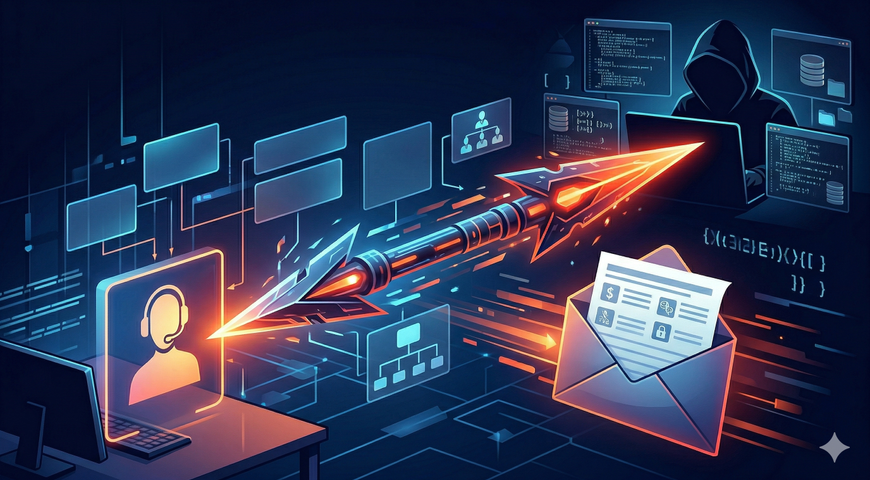
Spear phishing is one of the most dangerous and consistently effective threats in the modern cybercrime toolkit. According to the FBI’s 2024 Internet Crime Report, phishing was the single most reported cybercrime in the United States — and the targeted, personalized variant known as spear phishing is a primary driver of the costliest breaches organizations face today.
Key takeaways
• Spear phishing is targeted phishing. Unlike broad phishing campaigns, spear phishing attacks use research-driven personalization to target specific individuals or small groups — making them significantly harder to identify.
• The human element remains the primary attack surface. The Verizon 2024 DBIR found the human element was present in 68% of confirmed breaches; spear phishing attacks are specifically designed to exploit this.
• Time pressure is a core tactic. The median time to fall for a phishing email is under 60 seconds (Verizon 2024 DBIR) — spear phishing attacks are engineered around this window.
• BEC is spear phishing at scale. Business email compromise — which cost organizations $2.77 billion in 2024 according to the FBI IC3 — typically relies on spear phishing to impersonate trusted senders and authorize fraudulent transactions.
• Training alone is not enough. 71% of organizations experienced a successful phishing attack in 2023 despite growing awareness programs (Proofpoint 2024 State of the Phish, vendor research). Technical controls are essential alongside human training.
Defense requires layers. Effective spear phishing protection combines email security, URL filtering, MFA, user training, and backup and recovery capabilities.
What is spear phishing?
Spear phishing is a targeted subset of phishing — a broader category of social engineering attack in which cybercriminals use deceptive communications to manipulate victims into taking unsafe actions. In a spear phishing attack, those communications are not generic. Spear phishing messages are carefully customized for a specific target: they may reference the victim’s name, their employer, their role, or even recent events in their professional life.
Like all phishing attacks, spear phishing typically arrives via email, though spear phishing attempts can also occur via SMS (smishing), voice calls (vishing), or messaging platforms. The goal of a spear phishing attack is to trick the recipient into one of several harmful actions: clicking a malicious link, downloading malware, disclosing credentials, or transferring money.
Spear phishing vs. phishing: what’s the difference?
The core difference between phishing and spear phishing is precision. Standard phishing casts a wide net, sending generic messages to large numbers of recipients in the hope that some will take the bait. A spear phishing attack, by contrast, is a deliberate, researched operation aimed at a specific person or a narrowly defined group.
This distinction matters because personalization is exactly what makes spear phishing attacks so difficult to detect. A generic phishing email claiming “your account has been suspended” is easy for a trained employee to question. A spear phishing email that references the recipient’s actual manager, uses the correct internal terminology, and includes a plausible request tied to the recipient’s specific role is a far more credible threat.
According to Proofpoint’s 2024 State of the Phish report (vendor research based on a survey of 1,050 IT and security professionals across 15 countries), 73% of organizations reported experiencing spear phishing attacks — one of the most consistently cited targeted threat types in the survey.
How does a spear phishing attack work?
A spear phishing attack follows a deliberate, three-phase process.
Phase 1: target identification
Spear phishing attackers begin by selecting a target — either an individual or a small, defined group, such as the finance team at a specific company. High-value targets often include employees with access to financial systems, sensitive data, or administrative credentials.
Phase 2: reconnaissance
Once a target is identified, attackers gather personal and professional information to make their message believable. Common sources include corporate websites, LinkedIn profiles, press releases, and social media. In more sophisticated spear phishing campaigns, attackers may also leverage previously stolen credentials or data from prior breaches to add additional authenticity.
Phase 3: crafting and delivering the spear phishing message
Using the intelligence gathered, attackers craft a highly personalized spear phishing email or message. Spear phishing messages typically:
• Address the recipient by name and reference their role or team
• Appear to come from a trusted sender — a known colleague, manager, or internal department
• Create urgency, prompting the recipient to act before scrutinizing the request
• Ask the recipient to perform a specific action
That action is the payload. In a spear phishing attack, the recipient may be directed to:
• Reply directly with sensitive information (credentials, financial data, or personal details)
• Open an attachment that installs malware on their device
• Click a link to a malicious website designed to harvest login credentials or trigger a drive-by download
• Authorize a financial transaction, such as a wire transfer or invoice payment
A common example: a corporate accountant receives a spear phishing email that appears to come from their direct manager, written in the manager’s typical voice, requesting an emergency wire transfer to a new vendor. The email is convincing — and by the time the accountant realizes the request was fraudulent, the funds are gone. This type of attack is also known as business email compromise (BEC), and according to the FBI’s 2024 Internet Crime Report, BEC attacks cost organizations $2.77 billion in reported losses in 2024 alone.
Why is spear phishing so effective?
Spear phishing is effective because it is built around trust — and trust is difficult to systematically verify under time pressure.
The Verizon 2024 Data Breach Investigations Report found that the median time for an employee to fall for a phishing email is under 60 seconds. That window is far shorter than most formal verification processes, and spear phishing attackers deliberately engineer urgency to exploit it. When an email appears to come from a trusted source, uses familiar language, and makes a request that seems plausible given the recipient’s actual job responsibilities, the psychological barriers to compliance fall away.
The same report found that the human element was involved in 68% of all confirmed breaches analyzed. Spear phishing attacks are designed specifically to exploit that human element — making them resilient against purely technical defenses.
Several factors amplify this effectiveness:
Sender impersonation. A spear phishing email may appear to originate from a real colleague’s email address — either through domain spoofing or, in more advanced spear phishing attacks, because the attacker has already compromised that account using previously stolen credentials.
Contextual plausibility. Because spear phishing messages are built on real research, they contain details that generic phishing messages cannot replicate. A recipient who would ignore a vague password-reset prompt may not question a message that references an actual project they’re working on.
Generative AI. Emerging evidence suggests that threat actors are increasingly using AI tools to improve the quality and personalization of spear phishing messages at scale — reducing spelling errors, adapting tone, and translating content into multiple languages with greater precision. According to Proofpoint’s 2024 State of the Phish (vendor research), organizations across Japan, South Korea, and the UAE saw notable increases in business email compromise attacks, with Proofpoint attributing part of this growth to AI-assisted message generation enabling attacks in languages that were previously harder to fake.
Training is necessary — but not sufficient. Proofpoint’s 2024 State of the Phish found that 71% of surveyed organizations experienced at least one successful phishing attack in 2023, even as security awareness programs have expanded. Training reduces risk, but spear phishing attacks are specifically engineered to bypass a trained user’s instincts.
How to protect your organization against spear phishing
Defending against spear phishing requires a layered approach that combines technology controls with human preparedness. No single measure is sufficient on its own.
Email security. Advanced email security solutions scan inbound messages for indicators of spoofing, malicious attachments, suspicious links, and business email compromise patterns before they reach the recipient’s inbox. Effective email security applies DMARC, DKIM, and SPF authentication to block domain impersonation, and uses behavioral AI to flag anomalous sender–recipient relationships. Learn more about email threat prevention and how it works.
URL filtering. Even when a spear phishing email evades initial detection, URL filtering can prevent users from reaching the malicious websites linked within those messages. Real-time URL analysis and web filtering block access to known phishing pages, credential harvesting sites, and drive-by download locations. See how Acronis URL filtering works.
Multi-factor authentication (MFA). Even if a spear phishing attack successfully captures credentials, MFA creates an additional barrier that prevents attackers from immediately using those credentials to access systems.
Security awareness training. Employees should be trained to recognize the signs of spear phishing — including unexpected urgency, unusual financial requests, and sender addresses that don’t match the display name. Regular phishing simulations help reinforce this training in realistic conditions.
Verification procedures. Organizations should implement out-of-band verification processes for high-risk actions, such as wire transfers or changes to payment details. A quick phone call to confirm a request using a known, trusted number can break the spear phishing attack chain before damage occurs.
Acronis Cyber Protect Cloud: defense against spear phishing
Acronis Cyber Protect Cloud delivers protection against spear phishing attacks as part of a comprehensive, integrated cyber protection solution. URL filtering capabilities prevent users from reaching the malicious websites used in spear phishing attacks, while an AI-driven anti-malware engine identifies and blocks harmful processes from executing on users’ systems — providing defense against both known threats and novel, previously unseen attack variants.
In the event of data or system compromise, the integrated backup and recovery capabilities of Acronis Cyber Protect Cloud can quickly restore entire workloads — minimizing downtime and operational impact even when a spear phishing attack succeeds.
This unified approach enables Acronis to deliver efficient, easy-to-manage cyber protection for organizations and businesses of any size — reducing operational complexity while improving resilience against the targeted, personalized attacks that represent some of the most consequential threats businesses face today.
Frequently asked questions about spear phishing
What's the difference between phishing and spear phishing?
Phishing is a broad, high-volume attack type in which cybercriminals send generic messages to large numbers of people hoping some will take the bait. Spear phishing is a targeted variant in which attackers research their victim and craft a personalized message tailored to that specific individual — making it far more convincing and more likely to succeed.
What is a spear phishing email, and how do I recognize one?
A spear phishing email is a deceptive message crafted to appear legitimate to a specific recipient. Signs include: an unexpected request involving money, credentials, or sensitive data; a tone of urgency pushing you to act immediately; a sender address that almost matches a trusted contact but contains subtle differences; and requests that bypass normal procedures, such as a wire transfer without standard approval. When in doubt, verify the request through a separate, trusted communication channel.
Why is spear phishing harder to detect than regular phishing?
Spear phishing messages are built on real information gathered about the target — their name, role, colleagues, and organizational context. This personalization makes spear phishing emails look and feel like legitimate internal communications. Generic warning signs that flag standard phishing often don’t apply to a well-crafted spear phishing attack.
What is the most common goal of a spear phishing attack?
Spear phishing attacks typically aim to steal credentials, initiate fraudulent financial transfers, or deliver malware that enables follow-on attacks such as ransomware or data exfiltration. Business email compromise (BEC), which uses spear phishing to impersonate executives or trusted parties and authorize fraudulent payments, is one of the most financially damaging outcomes.
Can security awareness training stop spear phishing?
Training is a critical part of any spear phishing defense — but it is not sufficient on its own. Even with active awareness programs, most organizations continue to experience successful phishing attacks. Effective spear phishing defense requires training alongside technical controls: advanced email security, URL filtering, multi-factor authentication, and backup and recovery capabilities to limit the damage when an attack succeeds.
About Acronis
A Swiss company founded in Singapore in 2003, Acronis has 15 offices worldwide and employees in 60+ countries. Acronis Cyber Platform is available in 26 languages in 150 countries and is used by over 21,000 service providers to protect over 750,000 businesses.