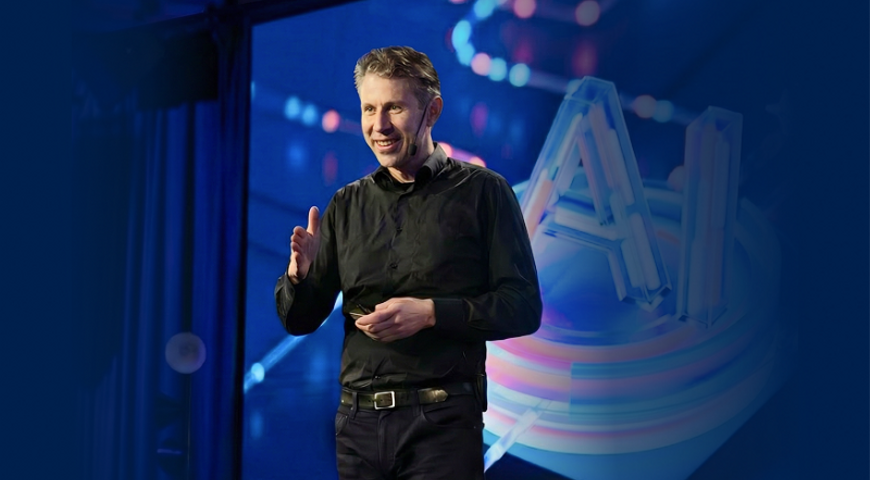
Artificial intelligence is changing how businesses work and compete. In every corner of the market, organizations expect more productivity. The question facing today’s business leaders is no longer whether to embrace artificial intelligence but how to harness its full potential to drive meaningful and sustainable transformation.
The productivity imperative in a borderless world
The shift to remote work has dissolved geographic boundaries, intensified competition and raised the stakes for service providers and enterprises alike. According to Acronis President Gaidar Magdanurov, “Almost every single person I meet has customers that are not local. A lot of MSPs, including your competitors, have customers worldwide now.”
The pandemic is chiefly to blame. This new reality brings with it a host of challenges: Talent retention is increasingly difficult, burnout is on the rise and client expectations have never been higher. Clients now demand not only flawless service but also lower prices and faster delivery with the expectation that AI will make everything cheaper and faster.
Traditional automation, once a reliable lever for efficiency, is showing its limitations. While automation excels at repetitive and well-defined tasks, it falters in today’s dynamic environment where needs and scenarios shift rapidly. “Automation is great but it’s not the solution,” Gaidar cautions. “Now with AI, we can really hack productivity.”

Three stages of AI adoption: From assistant to agent
Gaidar outlines a pragmatic roadmap for integrating AI into business operations — a journey that consists of three distinct stages:
- AI assistants: Most organizations are already leveraging AI in some capacity, whether drafting emails, analyzing logs or providing quick answers. At this stage, AI acts as a helpful assistant, augmenting human effort in an interactive, task-oriented manner.
- AI collaborators: The next phase sees AI learning from user activity, suggesting actions and helping to execute them. Here, AI becomes a true partner in daily work, bridging the gap between automation and human judgment.
- AI agents: Ultimately, AI evolves into an autonomous agent capable of executing tasks automatically with minimal human oversight. “Eventually, AI will become a part of the day-to-day business,” Gaidar predicts, though he acknowledges that organizations will need to calibrate their comfort level with automation.
Reclaiming human creativity: The true promise of AI
Perhaps the most profound impact of AI lies in its ability to liberate people from the mundane. By automating repetitive tasks, MSP businesses can not only onboard more clients and improve service quality but also reclaim the creative potential of their teams. “It actually helps us to grow capacity. So, the same team can do more. They actually work less and do more,” Gaidar explains.
Surveys reveal that technicians spend up to 60% of their day on repetitive, reactive tasks. With AI, that time can be redirected toward learning, innovation and strategic advising. “Instead of focusing on those tedious tasks, what they can do is focus on education — learning new tools and advising customers on strategic development of their business.” The result is a fundamental shift in the quality of work that empowers individuals to move beyond their daily routine and toward higher-value contributions.
A call to action: Preparing for the next wave
Guidance for leaders is both practical and urgent:
- Measure productivity: Move beyond tracking ticket volume by analyzing productivity per employee and monitor how it evolves over time.
- Prepare for AI: Document your infrastructure and processes. Identify what can be automated and how.
- Accelerate adoption: Most teams already use AI for basic tasks. Now is the time to integrate AI more deeply into your tools and workflows.
“AI will become your collaborator, not just your assistant,” Gaidar concludes. The organizations that recognize this inflection point and act on it will not only survive but thrive, unlocking new levels of productivity and human potential. As the business landscape continues to evolve, the challenge is not simply to keep pace with technological change but shape it by reclaiming creativity, driving innovation and redefining what it means to be productive in the age of AI.

About Acronis
A Swiss company founded in Singapore in 2003, Acronis has 15 offices worldwide and employees in 60+ countries. Acronis Cyber Platform is available in 26 languages in 150 countries and is used by over 21,000 service providers to protect over 750,000 businesses.