Generative AI and sophisticated social engineering have reshaped the cybersecurity landscape in 2026. Traditional "castle-and-moat" defenses centered on the Secure Email Gateway (SEG) are increasingly pressured by machine-scale attacks designed to bypass static filters.
As organizations shift toward Integrated Cloud Email Security (ICES) models, a new technical and psychological barrier appears: the "black box" problem of defensive AI. For the modern Security Architect, the mandate has shifted from chasing detection rates alone to demanding Explainable AI security---a framework where transparency and trust are as critical as the underlying algorithms.
Key takeaways
Industrialized phishing: Microsoft reports AI-automated phishing reached 54% click-through vs. 12% for standard attempts (4.5x).
The black box liability: In a survey of security professionals, 72% said false positives hurt productivity, and 59% said false positives take more time to resolve than true positives.
XAI frameworks: SHAP and LIME are common examples of ways teams explain model decisions (not vendor-specific by default).
Architectural evolution: A commissioned report found 87% of organizations are on the journey to move away from SEGs toward Microsoft controls and ICES.
The industrialization of phishing and the crisis of trust
Email-borne threats in 2026 are less about raw volume and more about economics: attackers can scale higher-quality lures faster. Microsoft's 2025 Digital Defense Report highlights that AI-automated phishing emails achieved 54% click-through rates compared to 12% for standard attempts---and can scale targeted attacks to thousands of recipients at minimal cost.
Email-borne threats in 2026 are less about raw volume and more about economics: attackers can scale higher-quality lures at lower cost. Microsoft’s 2025 Digital Defense Report highlights that AI-automated phishing emails achieved 54% click-through rates compared to 12% for standard attempts—and can scale targeted attacks to thousands of recipients at minimal cost.
As these higher-quality attacks scale, defenders are pushed to automate high-stakes actions (block, quarantine, warn). But when a system blocks a legitimate invoice or partner email without a clear “why,” security teams inherit a trust problem, not just a detection problem.
AI vs. Manual Phishing Metrics (2025–2026)
• Secure Email Gateway (SEG): A perimeter-style email filter that typically sits "in front" of the mailbox environment.
• Integrated Cloud Email Security (ICES): API-integrated security that operates within or alongside cloud email environments (often positioned for better visibility and faster response).
• Black-box AI: An AI system that provides verdicts/actions without clear reasons or supporting evidence that humans can validate.
• Explainable AI security: The ability to understand why an AI system produced a decision---supported by evidence, context, and an auditable trail.
What Explainable AI Security Looks Like in Practice
In AI email security, explainability typically means the verdict is not just "malicious" or "benign," but includes:
• What was detected (signal or indicator)
• Why it matters (risk rationale)
• What action was taken (quarantine/block/allow)
• What evidence exists (forensics and audit trail)
This is the practical shift from opaque scoring to decision transparency.
How AI email security detects social engineering (what matters in 2026)
Modern social engineering is rarely just "a bad attachment." Advanced defenses combine multiple signal types.
1) Behavioral and linguistic signals
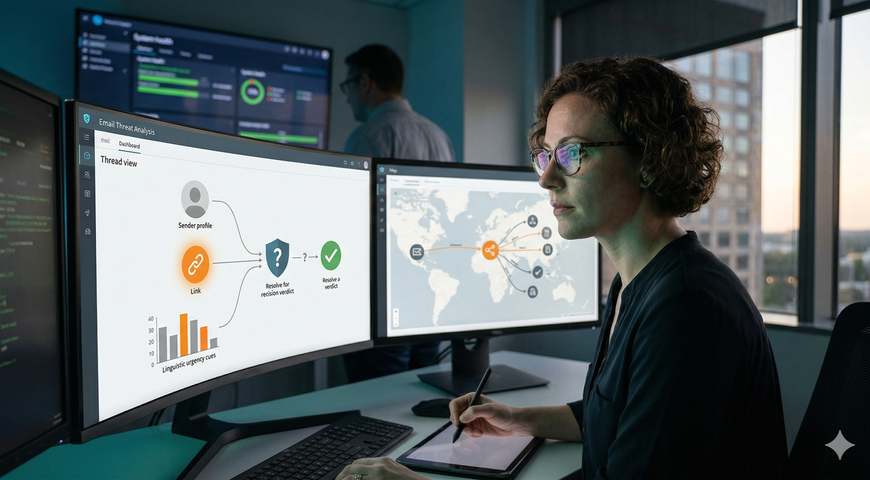
This is where natural language processing in email security is often discussed: urgency cues, persuasion patterns, and context signals. Some platforms also analyze relationship patterns between senders and recipients to identify BEC-like behavior.
2) URL, file, and evasion analysis
Acronis Email Security describes multiple layers relevant to explainability and investigation, including:
• Recursive unpacking: recursively unpacking files and URLs to analyze each component with static and dynamic engines.
• URL reputation checks + ML-driven DMARC validation to reinforce protection.
• AI-powered threat analysis and image recognition to help stop phishing/spoofing/impersonation attempts.
• CPU-level technology (Perception Point) that blocks exploits before malware is released and produces a verdict in seconds.
• X-ray insights: forensics data per email + proactive insights and file/URL analysis for investigations.
• Comprehensive audit log for visibility into admin and incident response actions.
Why black-box AI is a liability
Black-box outcomes create repeatable operational failure modes:
• Productivity drain: false positives consume attention and slow throughput.
• Resolution delays: teams may spend more time proving something is a false positive than fixing a true positive.
• Trust erosion: when "why was my mail blocked?" can't be answered quickly, confidence drops in both the tool and the security team.
Explainable AI security is not just a "nice to have." It's how you keep response quality stable as automation increases.
Operational Challenges vs. XAI Benefits
The architectural shift: predictive AI vs. reactive filters (SEG vs. ICES)
Many organizations are reassessing perimeter-centric SEGs as cloud email becomes the operating center. A commissioned report found 87% of organizations are on the journey to move away from their SEG toward Microsoft controls and ICES solutions.
Explainable AI security only works in practice if the tool is easy to roll out broadly and covers the mailboxes you actually run. Acronis positions Email Security as cloud-native and quick to enable ("flip of a switch"), with API-based provisioning for Microsoft 365, and reduced SEG-style deployment friction by removing the need for additional MX record configurations. Acronis also states it protects mailboxes including Microsoft 365, Google Workspace, Open-Xchange, and other cloud-based or on-premises environments.
AI quarantine explanations for MSPs (what changes operationally)
For MSPs, Explainable AI security isn't an abstract concept---it shows up when a client asks, "Why was this email quarantined?" If the answer is just a score or a vague label, the ticket turns into back-and-forth, manual digging, and a credibility problem. The practical goal is simple: make the quarantine decision understandable enough that a technician can explain it quickly and consistently.
This is where Acronis' recent updates fit naturally into the workflow. Acronis introduced AI-driven quarantine explanations that generate a plain-language explanation for why an email was quarantined, so technicians can immediately see the rationale without having to reconstruct the decision from scratch. See what's new in Acronis Cyber Protect Cloud.
Acronis also added a unified email quarantine view that consolidates quarantined emails "whether flagged by Acronis or Microsoft" into one dashboard. Operationally, that matters because it reduces context switching during triage: a technician can review, manage, and release quarantined emails in one place instead of bouncing between consoles. See what's new in Acronis Cyber Protect Cloud.
Zero Trust and Microsoft 365 integration
In Zero Trust terms, the objective is verifiability. Authentication checks like SPF/DKIM/DMARC are important, but they don't always answer the question a security team needs to answer in the moment: "What evidence do we have that this message is safe or risky?" That's why Explainable AI security matters---even when identity checks pass, teams still need clear signals and rationale to validate intent and justify actions.
It’s also common for organizations to layer email security controls on top of Microsoft 365 because a measurable amount of phishing can still reach inboxes in real-world conditions. Check Point found Microsoft Defender missed 18.8% of phishing emails in a dataset of nearly three million emails. Worth noting: this data is from 2022 and should be treated as illustrative context, not a current benchmark.
Within that "layered controls" reality, Acronis' unified email quarantine view is a concrete operational improvement: it brings quarantined emails flagged by Acronis or Microsoft into one place. That supports a more consistent "why was this quarantined?" process, because the handling is centralized and easier to explain and document. See what's new in Acronis Cyber Protect Cloud.
FAQ (People Also Ask)
What is explainable AI in email security?
Explainable AI security is the ability to understand why an AI system flagged an email---turning a verdict into clear reasons, supporting evidence, and an auditable trail.
How does AI detect phishing?
AI email security typically combines multiple layers---URL/file analysis, evasion detection, and (in some platforms) language/context signals---to identify threats that evade static rules.
Why is black-box AI risky?
Black-box AI can create an accountability gap: teams spend longer validating outcomes, false positives consume time, and trust erodes when actions can't be explained.
Does explainable AI reduce false positives?
Explainability doesn’t automatically eliminate false positives, but it reduces their operational cost by making validation faster. more consistent, and easier to document.
What Acronis capabilities support explainability?
Acronis describes AI-driven quarantine explanations, unified quarantine handling, “X-ray insights” (forensics), and audit logging as operational capabilities within email security.
What's the practical difference between SEG and ICES?
SEG is perimeter-centric filtering; ICES is API-integrated security aligned to cloud mail workflows and response patterns (often positioned for improved visibility and faster operational control).
Don't let your defense be a black box. Download the Advanced Email Security Datasheet to see how Acronis describes AI-driven quarantine explanations, unified quarantine management, and forensic context for email security operations.
Related resources
• Acronis Email Security product page
• What's new: Email Security updates
• Combatting MSP tool sprawl with a unified approach to delivering cyber resilience
• How MSPs can close the Microsoft 365 security gaps that slow them down
About Acronis
A Swiss company founded in Singapore in 2003, Acronis has 15 offices worldwide and employees in 60+ countries. Acronis Cyber Platform is available in 26 languages in 150 countries and is used by over 21,000 service providers to protect over 750,000 businesses.