
For years, managed service providers have built their businesses around keeping client environments running. That often means monitoring systems, responding to alerts, resolving tickets and moving between management consoles to identify and address problems. Artificial intelligence is beginning to change that model.
Today, AI is still primarily an assistant. It can summarize information, generate content, accelerate research and help technicians complete individual tasks faster. These applications are valuable, but they only scratch the surface of AI’s potential.
The bigger opportunity is to move from using AI to complete tasks faster to using AI and automation to change how MSP work gets done.
Today’s MSP: AI as an assistant
Look at a typical MSP workflow and it is easy to see where time disappears.
A technician receives an alert, investigates it, moves between monitoring and security tools, gathers information, determines the appropriate response, completes remediation and updates a ticket. Multiply those interactions across clients and endpoints and even relatively simple issues consume valuable capacity.
AI can make individual steps faster. But making a manual process faster does not fundamentally change the operating model.
The more important question is: What happens when AI becomes part of the workflow itself?
The future MSP: From assistance to autonomy
The next evolution will be about building MSP operations in which AI, automation and integrated technologies work together to reduce manual intervention.
Instead of technicians spending their days swiveling between consoles, alerts, notifications and tickets, increasingly autonomous workflows can help identify issues, provide context and automate repetitive processes.
This is where AI can begin changing the economics of managed services.

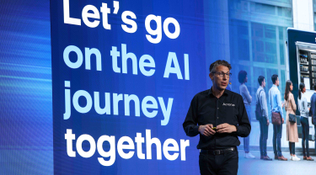
As Acronis CEO Prakash Panjwani recently explained, “You still have humans, but they're focused on the things that require attention rather than doing repetitive tasks. That's where AI really comes in.”
The goal is not an MSP without technicians. It is an MSP where skilled technicians spend less time on routine processes and more time solving complex problems, advising clients and applying expertise where it creates greater value.
Moving beyond manual firefighting
This shift could fundamentally change the technician’s role.
Traditionally, MSPs have relied heavily on monitoring to understand what is happening across client environments. But visibility can also create an enormous volume of alerts and information that technicians must manually interpret and act on.
The autonomous MSP moves beyond simply monitoring problems toward connecting information with action.
Instead of a technician manually moving through:
Alert → investigate → switch tools → gather context → open ticket → remediate → document
AI and automation can increasingly support integrated workflows that reduce the repetitive work surrounding that process.
Technicians then move from being operators of individual tools toward orchestrators who manage exceptions, make higher-level decisions and focus where human judgment matters most.
Turning efficiency into growth
The business impact goes beyond saving technicians time.
If an MSP must continually add people to support every new client or service, growth eventually runs into capacity constraints. More autonomous operations offer a different path.
Greater automation can create additional capacity to serve clients and expand services without simply adding more manual work. It can also free teams to focus on areas that contribute directly to business growth, from developing new services to strengthening client relationships and winning new business.
That is where the future of AI for MSPs becomes much bigger than an AI assistant.
The MSP of the future will not be defined by how many alerts its technicians can handle. It will be defined by how much value the business can deliver before a technician ever needs to intervene.
Written by
About Acronis
Acronis is a leader in AI-native cyber protection, unifying data protection, cybersecurity, IT operations and hybrid infrastructure to deliver business continuity, security and compliance with less cost and complexity. More than 21,000 service providers trust Acronis to protect over 750,000 businesses in 150 countries. Acronis is headquartered in Schaffhausen, Switzerland.