

For MSPs, vulnerability assessment and patch management are challenging primarily because of scale. Every new customer adds another tenant to configure, monitor and maintain, which multiplies operational overhead and increases the risk of inconsistency.
The newly released cross-tenant, partner-level vulnerability assessment and patch management in Acronis RMM is designed to break this pattern. It enables MSPs to manage vulnerabilities and patches centrally across all customers while still accommodating customer‑specific requirements.
What the feature is
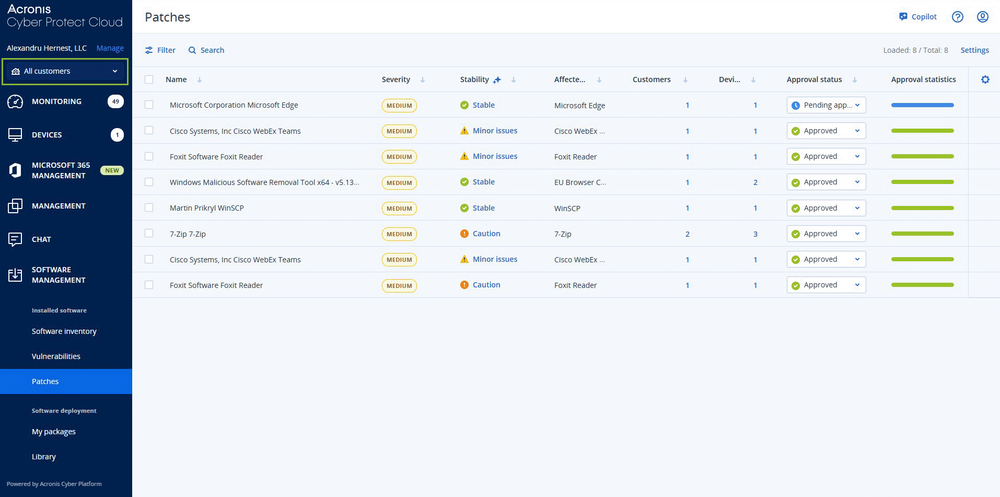
This feature introduces cross-tenant control for vulnerability assessment and patch management. Instead of configuring scans, approvals and patching separately for each customer tenant, MSPs can manage these workflows from a single view that spans all customers.
From a single partner-level view, you can:
- Configure vulnerability scan settings and schedules.
- Define patch management policies.
- Set patch approval rules, including automatic approvals.
- See detected vulnerabilities and available patches across all customers.
- Trigger patch deployment actions and drill down into specific customers or devices when needed.
The result is simple: visibility and control move to one place, so you no longer need to jump between tenants to understand patch status or enforce standards. Operational execution remains flexible, enabling MSPs to adjust policies where needed.
What problem it solves for MSPs
Before this capability, vulnerability assessment and patch management followed a tenant-by-tenant model. Each customer had to be configured individually, visibility into vulnerabilities and missing patches was fragmented, and approval processes had to be repeated for every tenant. Maintaining consistency depended largely on manual discipline and technician attention.
With partner-level management, this changes fundamentally:
- Operational overhead is reduced because policies are defined once and applied broadly.
- Visibility improves through a single view of vulnerabilities and patches across all customer tenants.
- Consistency increases because standards are enforced centrally instead of relying on repeated manual work.
At the same time, this approach remains flexible. Even though policies are defined centrally, MSPs can still override settings for specific customers, exclude certain patches or devices where required, and act at customer or device level when deeper intervention is needed.
In practice, the system provides centralized management by default, with the flexibility to define controlled exceptions when necessary.
Who benefits most
This capability delivers the most value for:
- MSPs managing many small or midsized customers.
- MSPs aiming to standardize security and patch hygiene.
- Teams seeking to reduce manual work, minimize errors and avoid constant tenant switching.
As the customer base grows, cross-tenant management turns vulnerability assessment and patch management into a scalable, repeatable process rather than a growing operational burden.
Try it today
If you are new to Acronis, start your free 30-day trial of Acronis Cyber Platform (formerly Acronis Cyber Protect Cloud) to explore cross-tenant vulnerability assessment and patch management.
If you are an existing partner, review the product documentation to learn how to configure and use this feature.
Written by
About Acronis
Acronis is a leader in AI-native cyber protection, unifying data protection, cybersecurity, IT operations and hybrid infrastructure to deliver business continuity, security and compliance with less cost and complexity. More than 21,000 service providers trust Acronis to protect over 750,000 businesses in 150 countries. Acronis is headquartered in Schaffhausen, Switzerland.