Business Continuity and Disaster Recovery (BCDR) Solutions

Business Continuity and Disaster Recovery (BCDR) Solutions

Business continuity and disaster recovery (BCDR) solutions help organizations keep critical operations running when cyberattacks, outages, human error or infrastructure failures disrupt normal work. Acronis helps detect incidents, contain impact, activate recovery resources and restore systems and data with minimal downtime.

What is business continuity and disaster recovery (BCDR)?

Business continuity is an organization's ability to keep essential functions running during and after a disruption. A business continuity and disaster recovery (BCDR) strategy combines processes, technology and predefined responses so that work continues even when part of the environment is unavailable.
Maintain operations

Maintain operations

Critical services stay available while affected systems are isolated and restored in the background.
Reduce or contain the blast radius

Reduce or contain the blast radius

Disruptions are detected early and isolated, preventing a single failure from cascading across the business.
Recover with confidence

Recover with confidence

Data and systems are restored to a known good state and validated before normal operations resume.

Downtime is expensive and disruption is constant

Modern operations depend on systems that can fail in multiple ways at once. Without a BCDR plan, a single event can halt revenue, block customers and stall internal teams for hours or days.

  • Cyberattacks

    Cyberattacks

    Ransomware and intrusions encrypt or destroy data and force systems offline.
  • Outages

    Outages

    Cloud, network or power outages cut off access to applications and data.
  • Human error

    Human error

    Accidental deletion or misconfiguration corrupts data and breaks workflows.
  • Infrastructure failure

    Infrastructure failure

    Hardware, storage or virtualization faults take production workloads down.
  • 59%
    of organizations were hit by ransomware in 2023
    Source: Spacelift, 2025
  • 24 days
    The average downtime an organization faces after a cyberattack
    Source: Spacelift, 2025
  • $9,000
    The cost of downtime per minute at the high end for many businesses
    Source: DotSecurity, 2024

How the BCDR process keeps operations running

An effective business continuity and disaster recovery process follows five clear phases. Each phase is a concrete action your teams carry out, not a document left on a shelf. Together they keep critical operations running and restore the rest.

  • Detect and assess

    The process begins as soon as a disruption occurs. Monitoring tools or staff catch the disruption early and size up the damage: which systems are affected, which business functions are blocked and how fast you need to act.
  • Contain and isolate

    Before the issue can spread, affected systems, regions or processes are isolated. This keeps the blast radius small and protects everything that is still running.
  • Activate and sustain

    With the threat boxed in, operations shift to alternate resources such as backup systems, redundant infrastructure or degraded workflows, so critical work keeps moving while the incident is handled.
  • Recover and verify

    Once it is safe, systems and data are restored from clean backups, then checked for integrity and functionality before returning them to production with confidence.
  • Resume and improve

    Finally, workloads return to primary systems and normal operations resume in a controlled sequence. The plan is then updated to close the gaps the incident exposed.

How BCDR solutions respond to different disruptions

The same BCDR process adapts to very different events. The table below shows how detection, containment and continuity activation play out, and the outcome each produces.

Disruption type
Detection
Containment
Continuity activation
Outcome
Ransomware attack
Security alert identifies malicious activity
Infected systems are isolated to prevent spread
Clean environments are restored from backups
Operations resume without paying ransom
Cloud outage
Monitoring tools detect service disruption
Affected region is isolated
Traffic shifts to secondary infrastructure or a secondary region
Services remain available with minimal downtime
Human error
Data inconsistency or failure is identified
Affected dataset is isolated to stop propagation
Previous data version is restored from backup
Operations continue without full system rollback
IT infrastructure failure
Hardware or system failure alert is triggered
Failing components are isolated
Workloads move to backup systems or environments
Internal operations are restored quickly

Key BCDR metrics: RTO, RPO, MTD and MTO

Business continuity is measurable. These four targets set how fast you must recover and how much data loss you can tolerate, and should map to each function's business priorities.
  • RTO

Recovery time objective

The target time to restore a system after an incident. An online store may need hours, while an internal reporting app may tolerate longer.
  • RPO

Recovery point objective

The maximum acceptable data loss, measured in time. It sets how often you back up.
  • MTD

Maximum tolerable downtime

The longest a function can be offline before the damage becomes irreparable.
  • MTO

Maximum tolerable outage

The acceptable disruption window for a specific operation before alternative processes must take over.

BCDR solutions for MSPs, SMBs and enterprises

The same five phases deliver different value depending on who runs them. Here is what a BCDR plan looks like for each audience.
Managed service providers

Managed service providers

  • Deliver SLA-backed continuity across multitenant environments from one console.
  • Isolate and recover a single client without affecting the others.
  • Standardize runbooks to scale the same plan across every account.
SMB and mid-market IT

SMB and mid-market IT

  • Run an enterprise-grade BCDR plan with a small team and one platform.
  • Recover from ransomware or hardware failure without specialist staff.
  • Automate backup, failover and recovery to cut manual effort.
Enterprise IT and risk leaders

Enterprise IT and risk leaders

  • Apply one consistent plan across distributed and hybrid infrastructure.
  • Map continuity to frameworks such as NIST and ISO 22301.
  • Report measurable resilience to the board with verified recovery.

How Acronis supports your BCDR strategy

Business continuity breaks down when monitoring, backup, security, and recovery rely on separate tools. Acronis brings these capabilities together in one natively integrated BCDR solution, helping organizations execute their BCDR strategy, reduce operational complexity, and recover faster from disruption.

Deliver BCDR as a scalable managed service

Protecting one business is challenging enough. Protecting dozens or hundreds requires consistent processes, centralized visibility, and automation. Acronis helps MSPs standardize service delivery, isolate client incidents, and meet recovery objectives from a single platform.
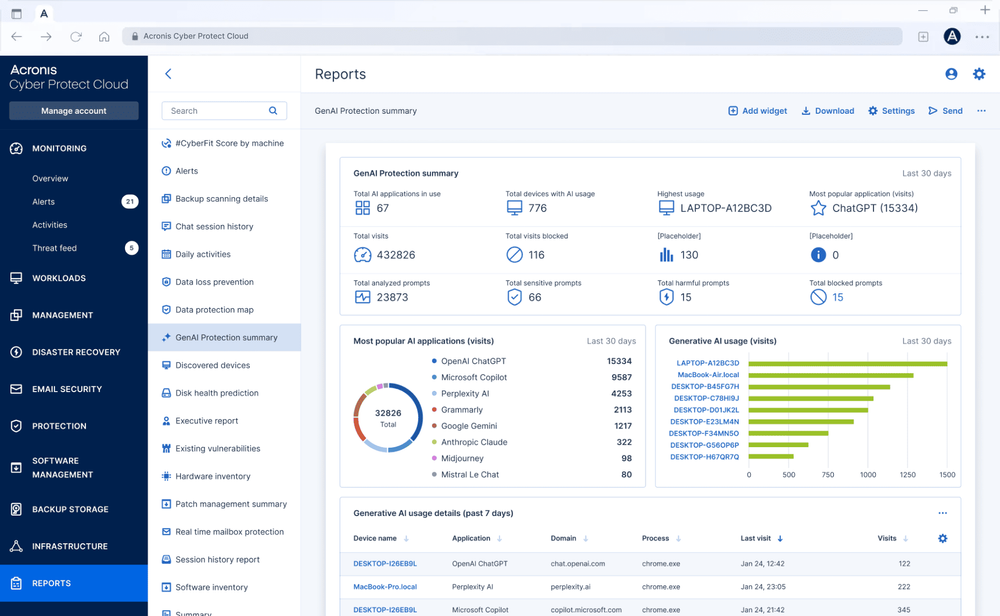
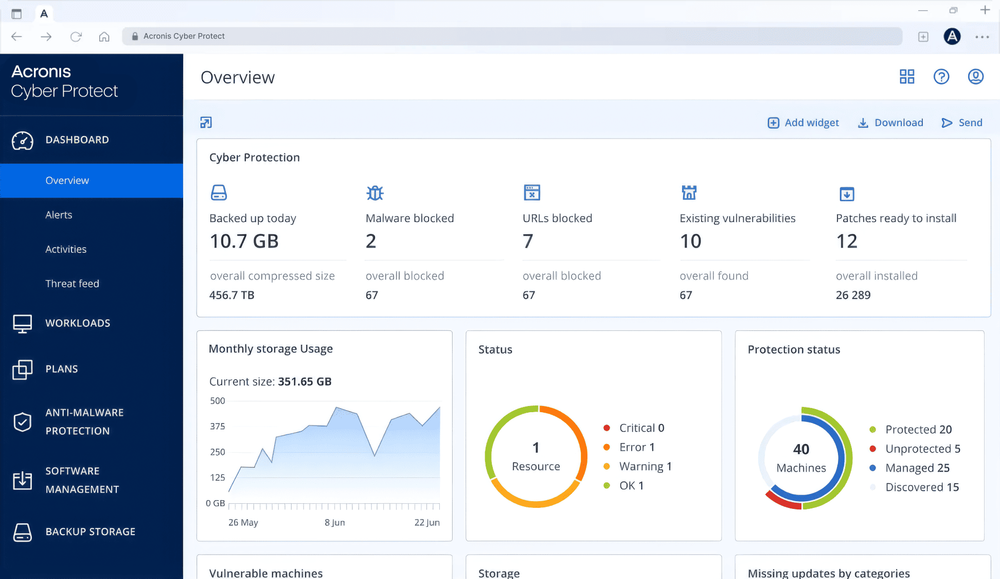
  • Centralize operations: Manage backup, disaster recovery, cybersecurity, and endpoint management across all client environments from one console.
  • Protect every tenant: Detect threats early, isolate affected workloads, and recover individual customers without disrupting others.
  • Automate service delivery: Use policy-based protection, automated recovery workflows, and centralized runbooks to reduce manual effort and improve consistency.
  • Meet recovery and SLA goals: Monitor recovery readiness, validate backups, and demonstrate compliance with customer SLAs through integrated reporting.
Deliver BCDR as a scalable managed service

Maintain business continuity from one platform

Business continuity depends on more than backup alone. Acronis combines cybersecurity, data protection, disaster recovery, and endpoint management to help organizations maintain critical operations and recover with confidence.
  • Identify and prepare: Assess operational risks, define recovery objectives such as RTOs and RPOs, and maintain immutable backups so clean recovery points are always available.
  • Protect and detect: Monitor endpoints, workloads, email, and cloud environments with integrated anti-malware, EDR, and XDR to identify and contain threats early.
  • Respond and recover: Restore clean systems with cloud disaster recovery, automated failover, and rapid recovery capabilities that minimize operational downtime.
  • Manage and improve: Centralize protection, security, recovery, and reporting to simplify operations, strengthen resilience, and continuously improve your BCDR strategy.
Maintain business continuity from one platform

Strengthen your business continuity strategy

See how Acronis brings cybersecurity, data protection, disaster recovery, and endpoint management together to help you maintain operations and recover faster from disruption.


Acronis is trusted by

  • Acronis is trusted by
  • Acronis is trusted by
  • Acronis is trusted by

Business continuity in the real world

Real Acronis customers and partners keeping operations running through disruption.
  • Technotic delivers zero-downtime recovery
    Financial services

    Technotic delivers zero-downtime recovery

    “Acronis’ recovery enabled us to be there the next morning with a replacement computer. Everything was exactly the way it was before the tea was spilled. The customer experienced no downtime — just an email saying there was no operational impact. Without Acronis, that would not have been possible.”
  • Cintech triples its client base
    Disaster recovery

    Cintech triples its client base

    “Since adopting Acronis, we have been able to triple our customer base using the same resources. The platform is easy to configure and provides rapid data recovery, allowing us to scale efficiently.”

  • Diamatix protects industrial environments
    Manufacturing

    Diamatix protects industrial environments

    “Electricity can fail. Anything can happen. In any natural disaster, manufacturers need a proper disaster recovery plan, including the ability to recover somewhere else. Disaster recovery is not optional in these environments.”

Frequently Asked Questions

Common questions about business continuity

Sorry, your browser is not supported.

It seems that our website is incompatible with your current browser's version. Don't worry, this is easily fixed!
To view our complete website, simply update your browser now or continue anyway.