
Phishing protection solutions for modern email and collaboration threats
Protect users from business email compromise (BEC), credential theft, QR-code phishing and AI-generated attacks with layered email security and integrated recovery.
Phishing continues to run rampant
An employee clicks a malicious link and enters credentials, and the flow of data to cybercriminals begins almost immediately. What starts as a single click can quickly lead to account compromise, business email compromise (BEC), ransomware and operational downtime. Organizations need to understand both the scale of the threat and how to reduce its impact.
“Phishing remains the most common human-centric access vector, frequently enabling credential capture or malware delivery that later facilitates broader compromise.”
- 83% of email threatswere phishing-related in H2 2025Acronis Cyberthreats Report, H2 2025
- 60% of datainvolved the human elementVerizon 2025 Data Breach Investigations Report DBIR
- $4.67 millionaverage cost of a credential breachIBM Cost of a Data Breach Report 2025

Threat type
How it works
Why it succeeds
Key risk indicator
Business email compromise (BEC) | Attackers impersonate executives, customers or partners to trick employees into transferring money or sharing sensitive information. | Impersonation attacks can appear legitimate, even when standard authentication checks pass. | Financial fraud, wire transfer scams and executive impersonation attacks continue to increase. |
Credential theft | Phishing pages steal credentials and session tokens used to access Microsoft 365, Google Workspace and other business systems. | AI-generated phishing emails often avoid the keywords, formatting patterns and known signatures that traditional filters rely on for detection. | Attackers can move from a single compromised account to wider business disruption. |
Ransomware delivery | Phishing emails remain one of the primary delivery methods for ransomware, malware and malicious attachments. | Attackers use QR codes, embedded payloads and collaboration-platform messages to evade traditional email defenses. | One click on a phishing link can lead to data encryption, system downtime and operational disruption. |
The phishing protection lifecycle
Effective phishing protection is not limited to blocking suspicious emails. Organizations need a lifecycle-based approach that helps prevent attacks, detect evasive techniques, contain compromise, restore affected data and recover operations quickly.
- Step 1
Prevent
Phishing protection starts with controls that reduce exposure to common attack techniques, including spoofing, impersonation and malicious links.
Relevant layers:
- Anti-spoofing protections
- URL and reputation analysis
- Step 2
Detect
Modern phishing attacks often use obfuscation, QR codes, embedded payloads and previously unknown techniques to evade traditional filters.
Relevant layers:
- Anti-evasion analysis
- QR-code recognition
- Dynamic threat detection
- Step 3
Contain
When a phishing attack succeeds, organizations need to act quickly to prevent further spread.
Key actions:
- Isolate compromised accounts
- Revoke active sessions
- Block malicious senders, URLs or attachments
- Step 4
Assess
Security teams need to determine which systems, accounts and data were affected.
Key actions:
- Review email activity
- Review user actions and system activity
- Review security alerts
- Understand the scope of the incident
- Step 5
Restore
Affected data must be restored quickly to reduce disruption.
Key actions:
- Restore compromised mailboxes
- Restore files and collaboration data
- Restore Microsoft 365 or Google Workspace
- Step 6
Recover
After restoring systems and data, organizations can resume operations and strengthen defenses.
Key actions:
- Use granular recovery
- Verify backup integrity
- Review the incident
- Implement additional safeguards
Why organizations choose Acronis for phishing protection
Whether you are an organization protecting your employees or an MSP protecting your customers, a lifecycle-based approach helps reduce risk, limit disruption and ensure faster recovery.
- Layered phishing protectionBlock modern phishing techniques across email and collaboration platforms with layered detection and analysis, including anti-evasion analysis, URL and reputation analysis, QR-code recognition, anti-spoofing protections, and dynamic threat detection.
- Integrated recovery capabilitiesRecover critical data and restore normal operations quickly when phishing attacks lead to account compromise or data loss with Microsoft 365 and Google Workspace backup, granular recovery, ransomware rollback, and immutable storage.
- Unified cyber protection platformManage phishing protection, backup, and recovery through a single, natively integrated platform that reduces complexity, improves visibility, accelerates recovery, strengthens business continuity, and lowers total cost of ownership.
Phishing protection challenges vary by organization
Different organizations face different realities. Phishing protection should address what matters most to you.

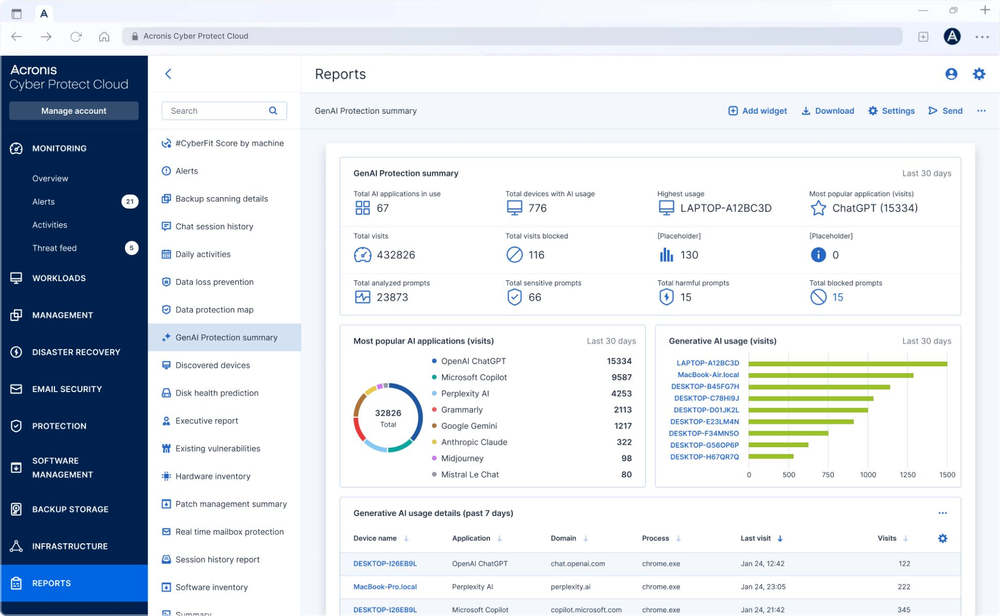
Learn how Acronis helps customers and partners reach their goals
Case study
Panathinaikos FC teams up with TicTac and Acronis against phishing attacks
“The #TeamUp experience brings people, clients and partners together to the training center of the sports team. You get to know the football players and the hospitality of their (Panathinaikos') marketing and IT teams.”
Frequently asked questions

Sorry, your browser is not supported.
It seems that our website is incompatible with your current browser's version. Don't worry, this is easily fixed!
To view our complete website, simply update your browser now or continue anyway.