






Author: Alexander Ivanyuk, Senior Director, Technology
Executive summary
Managed service providers (MSPs) are being asked to support more customers, more endpoints and more security services without always adding the same number of technicians. This makes operational reliability of the management layer a business issue, not only a technical issue. If a remote monitoring and management (RMM) agent, backup component, anti-malware service, endpoint detection and response (EDR) component, updater or remote access service is degraded, the MSP may lose visibility or spend technician time on manual recovery.
MSPs need to know not only that an agent is installed, but also that the agent and the services around it are healthy, recoverable and reporting correctly. The next step in this discussion is agent health assurance: A clearer operating model for detecting degraded states, helping technicians remediate issues faster, verifying whether recovery worked and moving over time toward more controlled self-recovery where it is safe and appropriate.
For customers, the key product nuance is important. Acronis has remediation capabilities, efficient operational shortcuts, monitoring signals, security posture visibility, alerting and technician workflows today. That is not the same as full auto-remediation for every agent-health scenario, but Acronis has a solid foundation and is building toward a more proactive model, where roadmap directions such as autonomous patch management, AI-assisted device preinstall checks for patch deployment, remediation actions across alerts and AI-assisted remote command line can help move MSP operations closer to controlled automation and platform-level observability.
Introduction: Why agent health matters more at MSP scale
For a single endpoint, an unhealthy agent can look like a small technical issue. For an MSP, the same issue becomes a business problem when it repeats across many customers and many devices. A technician may need to check whether the service is running, restart it, confirm that the endpoint is reporting, collect logs, and decide whether the issue is isolated or part of a larger pattern. This is work that takes time, and at MSP scale, small, repeated actions become expensive.
This is why the topic should be framed around operational resilience, not only endpoint protection. The agent is not just a piece of software on a device. For an MSP, it is the access point to management, monitoring, policy enforcement, remote actions, backup control, security signals, and customer service delivery. If the agent or a dependent service is not healthy, the MSP may still have a device record in the console, but the operational reality can be different.
Small and medium deployment (SMD) environments make this even more visible. These environments often include many customers, distributed users, laptops that sleep and wake, different network conditions and limited technician capacity. The endpoint estate may not be huge per customer, but the MSP sees the combined operational load across many customers. This is why a health issue that looks minor on one device can become a repeatable service-quality problem across the managed base.
The industry context also supports this direction. MSP reports continue to point to efficiency, automation, and service differentiation as important themes for service providers. This does not mean every operational task should be automated immediately. It means that the platform should help MSPs reduce avoidable manual work, keep technicians focused on true exceptions, and provide clearer evidence that managed services are working as expected.
Problem statement: Installed does not always mean healthy
In many endpoint management conversations, the first question is whether the agent is installed. In real MSP operations, that question is not enough. A device may have the agent installed and still be operationally degraded. The RMM service may be stopped. Backup may not be running. Anti-malware may not report correctly. EDR telemetry may be stale. The update service may fail after a reboot. Remote access may not be available when a technician needs it.
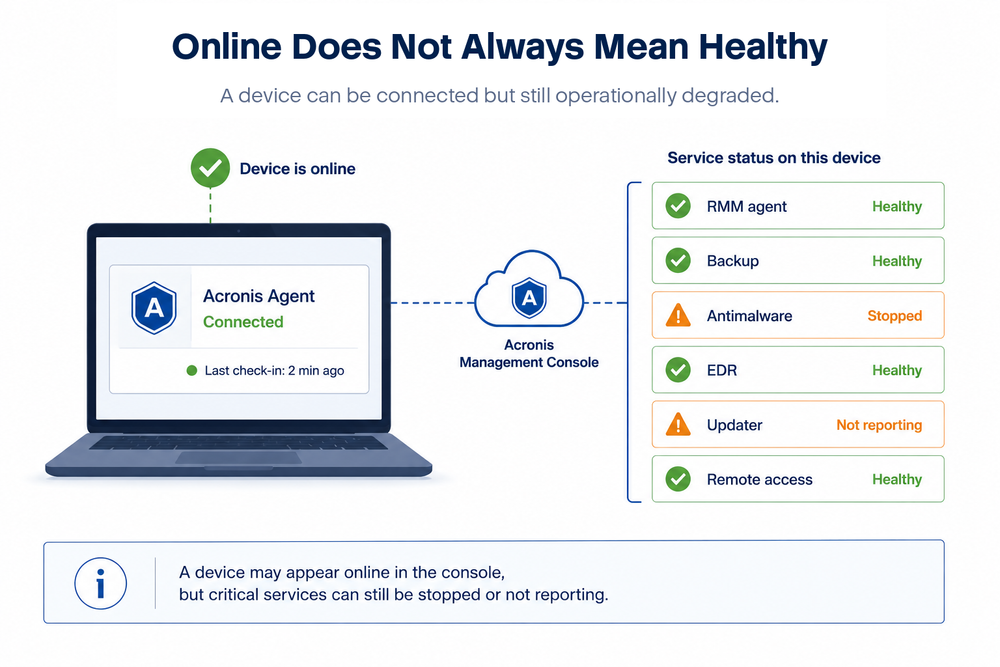
This creates a gap between technical deployment and operational assurance. Deployment answers the question, “Is the component present?” Operational assurance answers a more useful question for an MSP: “Is the component working, reporting, recoverable and trustworthy enough to support service delivery?”
The problem is not limited to one specific service. It can appear in the agent itself or in the services connected to protection, backup, monitoring, updating, remote access and policy enforcement. The MSP may not discover the issue until a task fails, a backup status is missing, an alert is not raised as expected or a customer reports that something cannot be managed remotely.
The important point is that these are normal operational situations, not exotic edge cases. Laptops sleep and wake. Users move between networks. Services start in the wrong order. Devices restart after updates. Temporary network loss can interrupt communication. Dependencies may not be ready when a service starts. The more endpoints an MSP manages, the more often these ordinary events can create operational noise.
What MSPs are really asking for
The customer and partner expectation behind this topic is practical. MSPs want the platform to be more proactive when the agent or related services are not healthy. They want fewer cases where a technician has to discover the problem manually, restart a service manually or check the same device repeatedly to confirm whether the issue came back.
Some MSPs already create their own operational workarounds. A common example is a scheduled restart of an RMM agent or related service as a preventive measure. Another example is delayed service startup after laptops wake from sleep, so that network and system dependencies have more time to become ready. These workarounds can help, but they also show that MSPs are trying to compensate for a broader reliability and visibility need.
The core request is not “automate everything.” MSPs need control. They need to decide what actions are safe, where they apply and when a technician should be involved. The real request is for better operational assurance: clear visibility, faster remediation, a verification loop, and escalation only when automation or assisted remediation cannot resolve the issue safely.
This is also why the issue should not be described as only an RMM problem. RMM is the starting point because it is often the management layer. But the operational view needs to include other important services as well, including backup, EDR, antivirus or anti-malware, update services, remote access and policy enforcement. For an MSP, all of these services contribute to whether the customer environment is truly protected and manageable.
Acronis capabilities today: Remediation now, self-recovery as an evolution
Acronis customers can already rely on important building blocks: a unified cyber protection platform, endpoint management, security services, RMM capabilities, backup, monitoring, alerting, secure scripting, remote access and remediation-oriented workflows. These capabilities are part of the broader Acronis Cyber Platform (formerly Acronis Cyber Protect Cloud) and Acronis RMM value proposition.
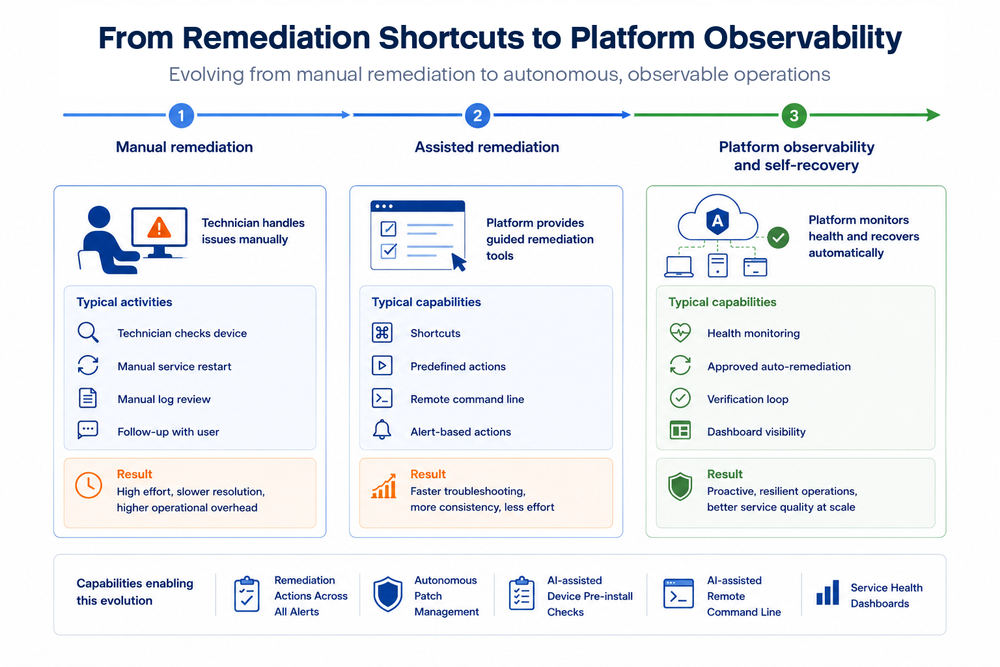
At the same time, it is important to describe the current product state precisely. The platform has remediations and efficient shortcuts today, but not full auto-remediation for all degraded agent or service states. This distinction matters because customers trust precise product language. A remediation action helps a technician or administrator fix a known issue more efficiently. A shortcut reduces the number of steps needed to perform a fix. Auto-remediation would mean the platform detects the condition, applies an approved recovery action, verifies the outcome and escalates only if the issue remains.
The product direction can still be described positively. Future and roadmap-oriented areas such as autonomous patch management, AI-assisted device preinstall checks for patch deployment, remediation actions across alerts and AI-assisted remote command line can help move the platform closer to a more proactive operational model. These are not claims that every agent health issue is already solved automatically today. They are examples of how the platform can evolve from technician-assisted remediation toward more consistent, controlled and observable operations.
Health visibility: Not starting from zero
The second important nuance is that Acronis is not starting from zero on health visibility. There are already relevant visibility building blocks. For example, anti-malware monitoring can show service-level health signals on a per-device basis and raise alerts that can be tracked together with alerts from other services. #CyberFit functionality is also relevant because it looks at different aspects of device protection and readiness. It helps frame endpoint posture in a more structured way, existing signals can become more valuable if they are brought together into a broader MSP service-health view.
The next step is to connect these signals more clearly across the platform. MSPs do not only want to know whether one service is healthy on one device. They want to understand whether the services that support protection, management, backup, updates and remote operations are healthy across customers and device groups. That is a platform-level observability problem.
In this model, alerts remain useful, but they are not the whole answer. Alerts tell the MSP that something happened. Observability helps the MSP understand the current operational state, the pattern across the fleet, the services affected, the recovery actions attempted and the devices that still require technician attention.
Self-defense and self-recovery are different problems
Acronis already has a strong security story around protecting the agent and the endpoint. This is important because management and security agents are high-value targets. If an attacker or unauthorized user can stop, modify or abuse the agent, the MSP loses control. Self-defense helps keep the agent and protection controls trusted.
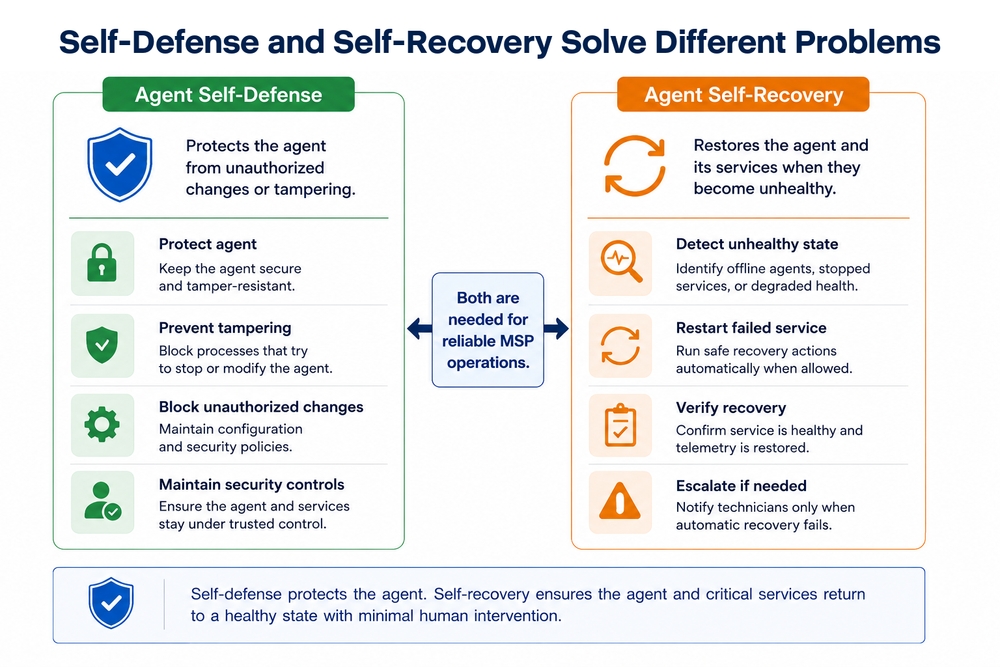
Self-recovery is a different operational problem. It is not mainly about stopping an attacker. It’s about keeping the agent and related services working when normal failures happen. A service may fail after a restart. A laptop may resume from sleep before the network is ready. A service may be running but not reporting. A component may become stale after an update. These are ordinary operational failures, and they require a different response than tamper protection. Self-defense protects the agent, while self-recovery helps maintain the agent’s operational health. Both are important. Together, they create a stronger story for MSPs because the agent is not only protected from interference; it’s also part of a more resilient operating model.
For customers, this distinction is easy to understand. A locked door protects the building, but it does not repair the heating system if it stops working. In the same way, agent self-defense protects the agent, but health assurance and recovery workflows help keep the management and protection services functioning day to day.
Future model: Agent health assurance and controlled self-recovery
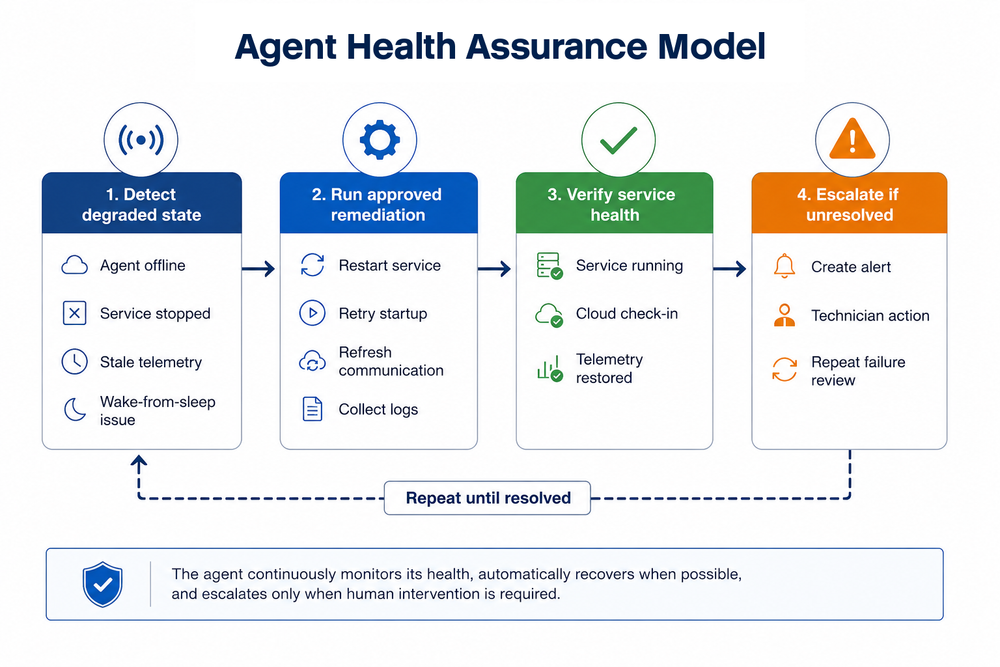
A practical future model should help MSPs understand whether core services are healthy, what recovery actions are available, whether those actions are safe to run automatically, and whether the issue was actually resolved. This model should be controlled, not uncontrolled automation. MSPs need to decide which recovery actions are allowed, which customers they apply to and which services can be restarted or repaired automatically. Some actions may be safe by default, such as restarting a stopped service. Other actions may require approval, such as reinstalling a component or making configuration changes.
The detection layer should look at the health of core services. This includes the RMM agent, backup services, antivirus or anti-malware, EDR, update services, remote access and policy enforcement. The platform should not only ask whether the device is online. It should ask whether the services that matter to MSP service delivery are running, communicating and reporting correctly.
The remediation layer should focus first on safe and common cases. If a service stops, restart it. If a service fails after wake from sleep, wait for dependencies and try again. If a service is running but not communicating, refresh the communication state or trigger a health check. If the issue repeats, collect diagnostics and escalate to a technician with useful context.
The verification layer is critical. A recovery action is not complete just because the system attempted it. The platform should confirm that the service is running, communicating and reporting expected telemetry. Without verification, an automatic restart can create false confidence. With verification, the MSP can trust the result more easily.
The escalation layer should be clear and selective. If recovery works, the event can be logged and shown in reporting. If recovery fails, or if the same issue repeats many times, the platform should raise the right alert and provide the technician with the context needed to act. This is how the MSP moves from routine manual checks to exception-based operations.
Dashboard direction: From device alerts to platform health visibility
The dashboard should help MSPs see platform health in a simple and useful way. It should not become another complex technical screen that requires manual interpretation. The first view should answer basic operational questions: How many devices are healthy, how many are degraded, how many recovered automatically or through assisted remediation and how many require technician action.
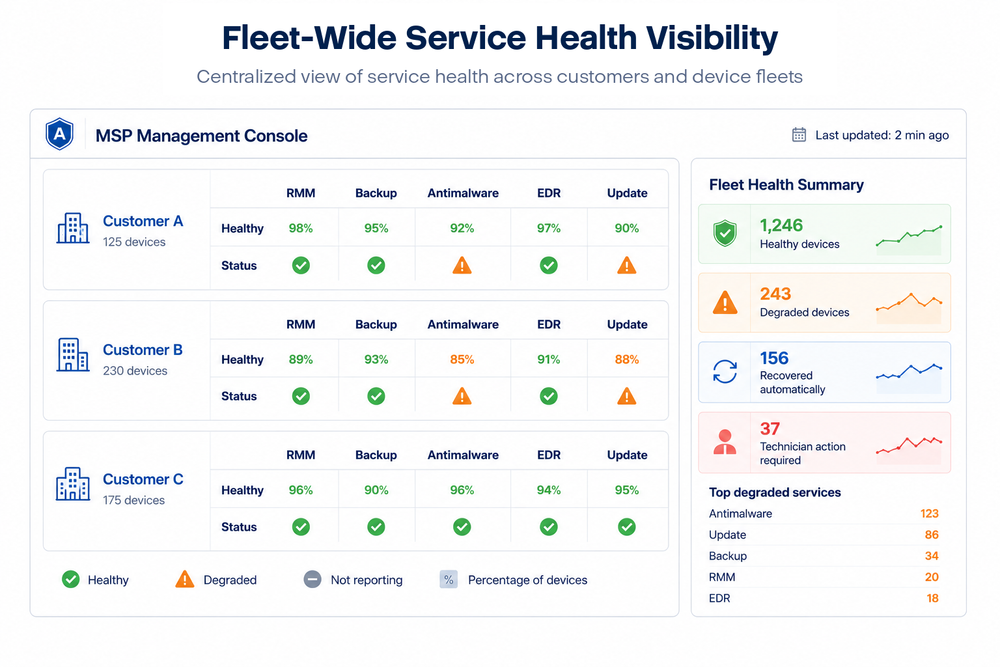
The dashboard should also show which services are affected. For example, an MSP should be able to see whether the main issue is with RMM, backup, antimalware, EDR, updates or remote access. It should be possible to filter by customer, device group, severity, operating system or repeated failure pattern.
This type of view is valuable because it changes the technician’s workflow. Instead of opening device after device to find the issue, the MSP can start with a service-health summary. The summary shows where attention is needed and where recovery has already succeeded. This is especially useful for service managers who need to understand trends, not only individual alerts.
A good dashboard should also include recovery history. If the platform restarted a service, the MSP should see when it happened, what policy allowed it, whether verification passed, and whether the issue happened again. This gives partners confidence in automation and helps them identify recurring root causes.
The goal is not to remove alerts. Alerts are still necessary. The goal is to organize alerts and health signals into a higher-level operational picture. For MSPs, that picture is what makes the difference between reactive troubleshooting and proactive service management.
Business value for MSP partners and customers
The business value of better agent health assurance is straightforward. MSPs spend less time on repetitive checks and manual service recovery. Technicians can focus on issues that require judgment instead of routine restarts. Service managers can see which customers or services have repeated problems. Customers receive more stable protection and management coverage.
This value becomes stronger as the MSP grows. At small scale, manual recovery may be acceptable. At larger scale, the same manual recovery becomes a cost. Every repeated service restart, every manual health check and every unclear alert consumes time. Better health visibility and controlled remediation help reduce that operational drag.
There is also a trust benefit. Customers may not care whether a service restart happened manually or through an approved workflow. They care that backup, security, remote access, and management services work reliably. They care that the MSP can see problems early and act before the customer has to report them. A stronger health-assurance model helps MSPs show that their services are controlled and reliable. This can support better service delivery. It gives technicians better context, helps reduce blind spots and creates a path toward more scalable operations. It also strengthens the value of a unified platform because health signals, alerts, remediation actions and reporting become more useful when they are connected.
Conclusion: Resilient operations are the next layer of MSP service quality
For MSPs, endpoint management reliability is now part of service quality. It is not enough to know that an agent is installed or that a device appears online. The MSP needs to know whether critical services are healthy, whether they are reporting correctly, whether common issues can be remediated efficiently, and whether unresolved problems are escalated with the right context.
Acronis has a strong foundation for this direction because its platform already brings together cyber protection, backup, endpoint management, monitoring, security, RMM, alerts and automation capabilities. The next layer is stronger operational observability and controlled self-recovery: Not as an overpromise that every issue is fixed automatically today, but as a practical direction for making MSP operations more resilient over time.
That is the shift from agent self-defense to agent health assurance. Self-defense keeps the agent protected. Health assurance helps MSPs understand whether the agent and related services are working. Controlled self-recovery can help the platform move from faster remediation toward more proactive operations where it is safe and policy approved.
For MSPs and their customers, the goal is simple: Fewer blind spots, fewer unnecessary manual actions, better service continuity and more confidence that managed endpoints are not only present in the console, but actually healthy and operational.